Why Education & Migration Consultancies Need a Different Marketing Playbook
This isn’t a typical local business sale. A student or their family is making a decision that affects years of their life and a significant amount of money, and they will research extensively before ever filling out an enquiry form.
That means trust signals, proof, and depth of information matter more here than in almost any other local-service category – a generic “contact us for a free consultation” website won’t cut it against a family doing weeks of comparison research.
The Decision-Making Journey Is Long and High-Stakes
Unlike booking a restaurant or buying a product, choosing a consultancy usually involves multiple family members, several weeks of research, and comparisons across five or more competing agencies before anyone reaches out. Your marketing needs to show up – credibly – at every one of those touchpoints, not just the final search that leads to an enquiry.
What This Means for Your Marketing
In practice, it means every channel needs to do double duty: generate visibility AND build credibility at the same time. A paid ad that gets a click but lands on a thin, generic page loses the trust it just spent money to earn. This is why the channels in this guide are designed to work together rather than as isolated tactics.
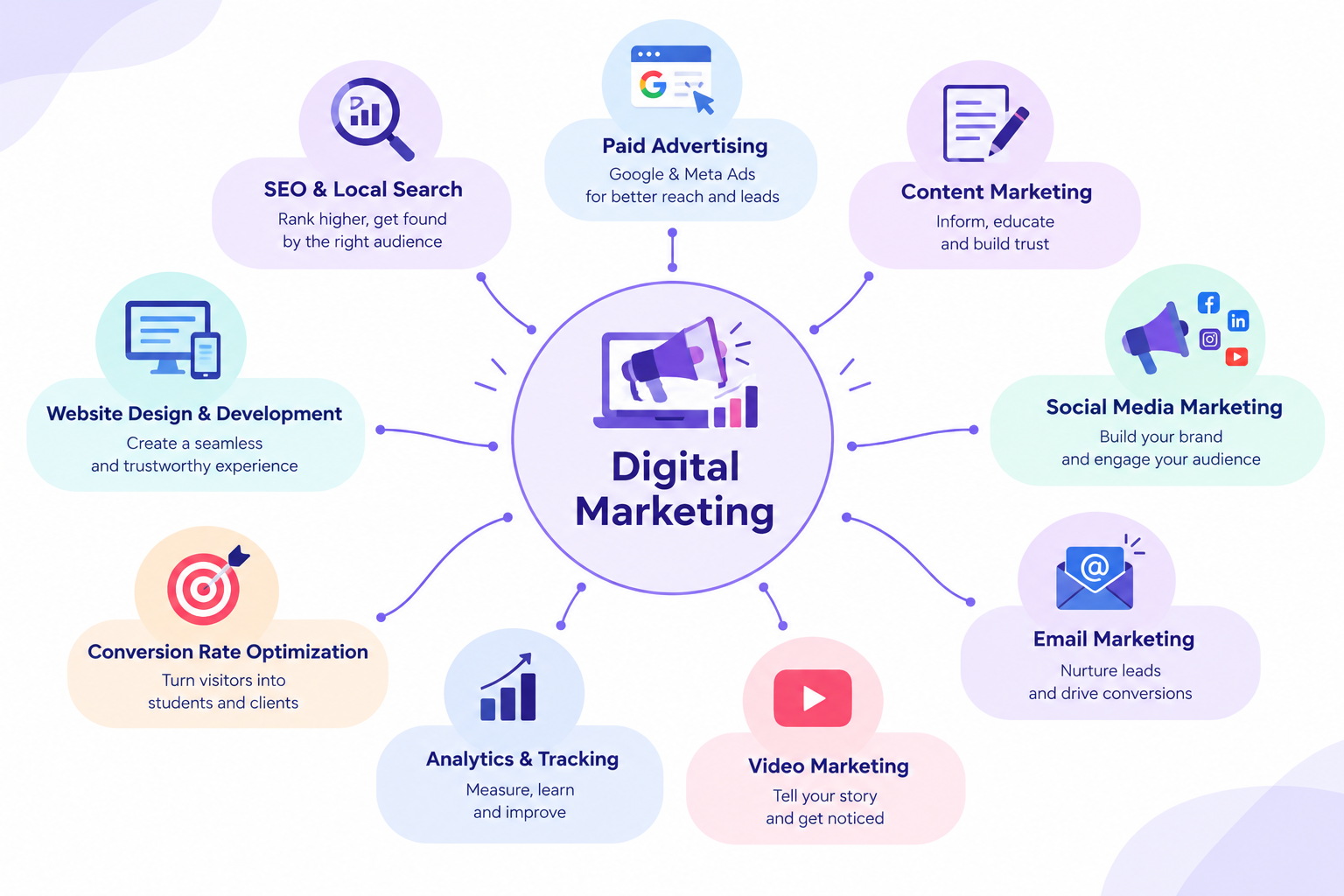
1. SEO & Local Search: The Foundation of Digital Marketing for Education Consultancies
Your foundation is ranking for the searches people actually run before choosing a consultancy: destination-specific terms (“study in Australia consultancy Kathmandu”), service-specific terms (“skills assessment help Nepal”), and problem-specific terms (“visa refused reapply”).
A well-structured Google Business Profile, consistent NAP (name/address/phone) data, and location-specific service pages do more for enquiry volume here than almost any other single investment.
Keyword Research for This Niche
Group your target terms into three buckets: destination-and-service combinations, problem-driven searches from people already mid-process, and comparison terms (“best education consultancy [city]”).
Problem-driven searches are often the easiest wins – lower competition, and the person searching is already deep in their decision journey.
Google Business Profile Optimization
Your GBP is frequently the first thing a prospective client sees, before they even reach your website. Complete every field, upload real office and team photos, post updates regularly, and actively collect and respond to reviews – profiles that look active and well-maintained convert noticeably better than bare-bones listings.
Location & Service Pages
If you operate from more than one office or serve multiple regions, each location needs its own dedicated page with genuinely unique content – not a shared page with a list of cities pasted at the bottom, which actively works against your rankings.
Technical SEO Basics
Fast load times, mobile-first design, and a clean site structure Google can crawl easily aren’t optional extras – they’re prerequisites. Google’s own Search Essentials guidelines are a useful baseline check before investing further in content or ads – a slow, cluttered site undermines every other SEO effort you make on top of it.
2. Paid Advertising: Google & Meta
Paid search captures people actively searching with intent; Meta captures people who haven’t started searching yet but fit your ideal profile. The two channels do different jobs in the funnel, and treating them identically – same broad targeting, same generic ad copy – is the single biggest reason consultancies waste ad spend.
Google Search Ads: Capturing Active Intent
Someone typing “Australia student visa consultant” into Google is close to a decision. Search ads should use tightly matched, specific keywords and land on a page that mirrors the exact promise in the ad – generic homepage landing pages consistently underperform dedicated, matching pages.
Meta Ads: Building Awareness & Retargeting
Meta works differently – it reaches people who fit your ideal client profile before they’ve started actively searching. It’s also where retargeting shines: showing ads to people who visited your site but didn’t enquire is often the highest-ROI use of Meta budget for consultancies.
Budget Allocation Framework
A sensible starting split is the majority of budget on Google Search (capturing existing demand), with a smaller, consistent allocation to Meta for awareness and retargeting – adjusting the ratio once real enquiry data shows which channel is actually producing enrolments, not just clicks.
3. Content Marketing & AEO – Being Found by AI Assistants
Search behaviour is splitting in two: people who type into Google, and a fast-growing group who ask ChatGPT or Gemini directly (“which consultancy handles nursing visas in Melbourne”).
Answer Engine Optimization – writing content structured so AI assistants can extract and cite it directly – is still a wide-open opportunity in this niche, because almost no competing consultancy is doing it yet.
What AEO-Structured Content Looks Like
Clear, direct answers near the top of the page, genuine FAQ sections addressing real questions, and content organised under specific, well-labelled headings – this is the structure both search engines and AI assistants can extract and cite most easily.
Content Topics That Convert
Prioritise the exact questions your counsellors get asked every week – visa processes, cost breakdowns, eligibility criteria, common mistakes – over generic “why study abroad” content. Specific, practical content earns both rankings and trust faster than broad, aspirational pieces.
4. Website & Conversion Rate Optimization
Traffic without conversion is a wasted budget. The consultancies that convert best treat their website as a qualification tool, not a brochure – eligibility checkers, clear enquiry forms, and visible proof (success stories, visa approval numbers, counsellor credentials) do more to move a hesitant visitor to “book a consultation” than any amount of extra traffic.
The Anatomy of a High-Converting Consultancy Website
A short eligibility or country-match quiz, a multi-step enquiry form broken into easy questions, prominent trust signals on every key page, live chat, and a visible booking calendar for counsellor calls – together, these turn passive browsing into active engagement.
Common CRO Mistakes
The most common issues: enquiry forms buried below the fold, generic stock photography instead of real team and office photos, and testimonials tucked away on a single page nobody visits instead of woven throughout the site.
5. Automation: Chatbots & CRM
A student browsing at 11 pm won’t wait until your office opens to get an answer – if a competitor’s chatbot responds instantly and yours doesn’t, that enquiry is gone. Pairing an AI chatbot for first response with a CRM that tracks every enquiry through to enrolment turns a leaky, spreadsheet-based process into a system you can actually measure and improve.
What a Good Chatbot Does
Answers common questions instantly, pre-screens basic eligibility, captures contact details conversationally, and routes qualified, ready-to-talk enquiries straight to a counsellor – while handing off anything sensitive or complex to a real person without friction.
CRM as Your Single Source of Truth
Without a CRM, enquiries live scattered across email, WhatsApp, and sticky notes, and it’s nearly impossible to know which marketing channel is actually producing paying clients. A CRM connects every inquiry to its source and outcome, which is what turns “we think ads are working” into “we know exactly which campaign produced 12 enrolments last month.”
6. Social Media & Trust Signals
Social proof compounds here more than most industries – a parent seeing a real success story from someone in their own community carries more weight than any ad copy you could write. Consistent, authentic student-journey content (not just logo posts) is what actually builds the trust this decision requires.
Platform-by-Platform Approach
Facebook and Instagram tend to reach parents and family decision-makers best; short-form video (Reels, TikTok, YouTube Shorts) tends to reach the student applicants themselves. A consistent presence on the two or three platforms your actual audience uses beats a thin presence spread across five.
Building Trust Through Content
Real student journeys – from first enquiry through to arrival – consistently outperform polished, generic promotional content. Consider a monthly “student spotlight” format as a low-effort, high-trust content engine that also feeds your website’s proof sections.
7. Measuring What Matters
Every channel above needs a different success metric – tracking the wrong one is how consultancies end up convinced a channel isn’t working when it actually is (or vice versa).
| Channel | Track This | Not Just This |
| SEO | Ranking movement on destination + service keywords, organic enquiry form submissions | Overall traffic alone |
| Paid Ads | Cost-per-enquiry and cost-per-enrolment | Click-through rate alone |
| Website | Enquiry form completion rate, eligibility-checker completions | Total page views |
| Chatbot | Conversations that convert into booked consultations | Number of conversations started |
| Social | Enquiries traced back to a specific post or story | Likes and follower count |
Building Your 90-Day Marketing Roadmap
Start with the foundations – Google Business Profile, core SEO pages, and a working enquiry form – before adding paid ads on top. Layer in one AEO-structured content piece per month and a basic chatbot in the first 90 days, then use what you learn from real enquiry data to decide where the next round of budget goes. For a broader framework on sequencing channels, HubSpot’s guide to building a marketing strategy is a useful outside reference.
| Phase | Focus |
| Days 1–30 | Claim/optimise Google Business Profile, fix NAP consistency, publish core service and location pages, get a working multi-step enquiry form live |
| Days 31–60 | Launch a small, tightly targeted Google Search Ads test; publish the first 1–2 AEO-structured content pieces; set up basic chatbot for after-hours response |
| Days 61–90 | Review enquiry data to see which pages/keywords/ads actually convert; add a CRM to track enquiry-to-enrolment; layer in Meta retargeting for site visitors who didn’t enquire |
Common Mistakes to Avoid
- Running paid ads to a generic homepage instead of a page that matches the ad’s specific promise
- Treating SEO as a one-time project instead of an ongoing effort – rankings won by outdated or unmaintained content don’t last
- Letting the chatbot handle sensitive or complex questions it isn’t built for, without a clear, fast handoff to a real counsellor
- Measuring vanity metrics (likes, page views) instead of enquiry-to-enrolment outcomes
- Trying to run every channel at once from day one instead of building foundations first and layering on
FAQ
Q: How much should an education consultancy budget for digital marketing?
It varies by market and ambition, but most consultancies see meaningful results starting with a modest, consistent monthly budget split across SEO/content foundations and a smaller paid ads test – scaling the channels that prove out with real enquiry data.
Q: Which channel should we prioritise first?
SEO and website foundations first – they compound over time and make every other channel (ads, social) work harder once they’re in place.
Q: How long before we see results from SEO?
Typically 3 to 6 months for meaningful ranking movement, though local search and Google Business Profile improvements can show impact sooner.
Q: Should we handle marketing in-house or hire an agency?
It depends on team capacity – many consultancies start in-house with basics like Google Business Profile and social posting, then bring in agency support once they’re ready to run SEO, paid ads, and content at scale simultaneously.
Q: How do we know if our website is actually converting well?
Compare your enquiry-form completion rate against the 3–8% range typical for this industry – if you’re well below that, the issue is usually missing trust signals or a form that’s too long, not a lack of traffic.
Q: What’s the biggest quick win most consultancies are missing?
A fully optimised, actively updated Google Business Profile – it’s often the first thing prospective clients see, and it’s the fastest foundation piece to fix.
Not sure which channels deserve your budget first? Book a free digital marketing audit with The Purple Bytes.