What Makes SEO for Immigration Consultants Different?
Because a wrong answer in this niche can cost someone their visa application, Google weighs expertise, authority, and trust signals more heavily here than in most local-service categories. Effective SEO for immigration consultants has to prove credibility, not just target keywords – registration numbers, named consultants, and accurate, current information all factor into how Google evaluates your site.
YMYL and Why It Raises the Bar
YMYL stands for “Your Money or Your Life” – Google’s internal classification for content that could impact someone’s health, financial stability, safety, or major life decisions. Immigration advice sits squarely in this category alongside medical, legal, and financial content.
Google’s Search Quality Rater Guidelines explicitly instruct human evaluators to hold YMYL pages to a stricter standard, which means the usual shortcuts – thin content, unverifiable claims, anonymous authorship – hurt far more here than they would for a lower-stakes topic.
What Google Actually Checks For
In practice, Google’s systems and quality raters look for signals that a real, accountable, qualified business stands behind the content: named authors with verifiable credentials, a clear About page, contact information that matches business registration records,
consistent and accurate information across the site, and a visible way for users to verify claims (registration numbers, review platforms, professional body listings). Sites missing these signals tend to plateau in rankings even with reasonable keyword targeting and backlinks.
Keyword Clusters That Actually Convert
Group your target keywords into three clusters: destination-and-visa-type terms, problem-driven terms, and process terms. Treating all of these as one undifferentiated “migration agent” keyword list is the most common strategic mistake in this niche – each cluster needs different page types, different content depth, and different calls to action.
Destination-and-Visa-Type Terms
Terms like “skilled visa consultant Australia” or “student visa agent Melbourne” combine a destination with a visa category. These are typically the most competitive terms in your space, but also the ones with the clearest commercial intent – someone searching this way has usually already decided on a destination and just needs to pick an agency.
Problem-Driven Terms
Terms like “visa refusal appeal help” or “partner visa evidence rejected” come from people already deep in a specific, often stressful situation. These terms are frequently lower competition than broad destination terms, and the person searching is highly motivated to book a consultation immediately – problem-driven content converts disproportionately well relative to its traffic volume.
Process Terms
Terms like “skills assessment ANMAC guide” or “NOC process for international students” target people researching a specific step in a longer journey. These rarely convert on the first visit, but they build topical authority and often become the entry point for a longer relationship – someone researching a skills assessment today may become a client six months later once they’re ready to lodge.
Building a Keyword Cluster Map
A simple way to organize this work is to map each cluster against the page type and funnel stage it serves, so your content calendar isn’t just a list of blog ideas but a structured system:
| Cluster | Best Page Type | Funnel Stage |
| Destination + visa type | Dedicated service/landing page | Bottom-of-funnel, ready to enquire |
| Problem-driven | In-depth blog post with a clear CTA | Mid-to-bottom funnel, urgent need |
| Process/educational | Blog post or resource hub article | Top-of-funnel, early research |
Service-Area & Location Pages
If you serve clients from multiple offices or across several regions, each location needs its own dedicated page with unique content – not a single page with a list of cities pasted at the bottom. Thin, duplicated location pages are one of the fastest ways to suppress your own rankings in this niche.
Why Duplicate Location Pages Get Suppressed
Google’s algorithms are specifically tuned to detect near-duplicate content across a site’s own pages. When five “city” pages differ only by a swapped place name, Google typically picks one to rank and treats the rest as redundant – meaning you’ve done the work of creating five pages but only get the SEO benefit of one.
What a Good Location Page Includes
- A named consultant or team based at (or serving) that specific location
- Locally relevant detail – nearby landmarks, local community context, region-specific visa pathways your clients from that area typically use
- Genuine testimonials or case studies from clients in that region, where available
- Its own unique meta title and description, not a templated variable swap
Read next: Digital Marketing for Education Consultancies
E-E-A-T Signals Google Rewards in This Niche
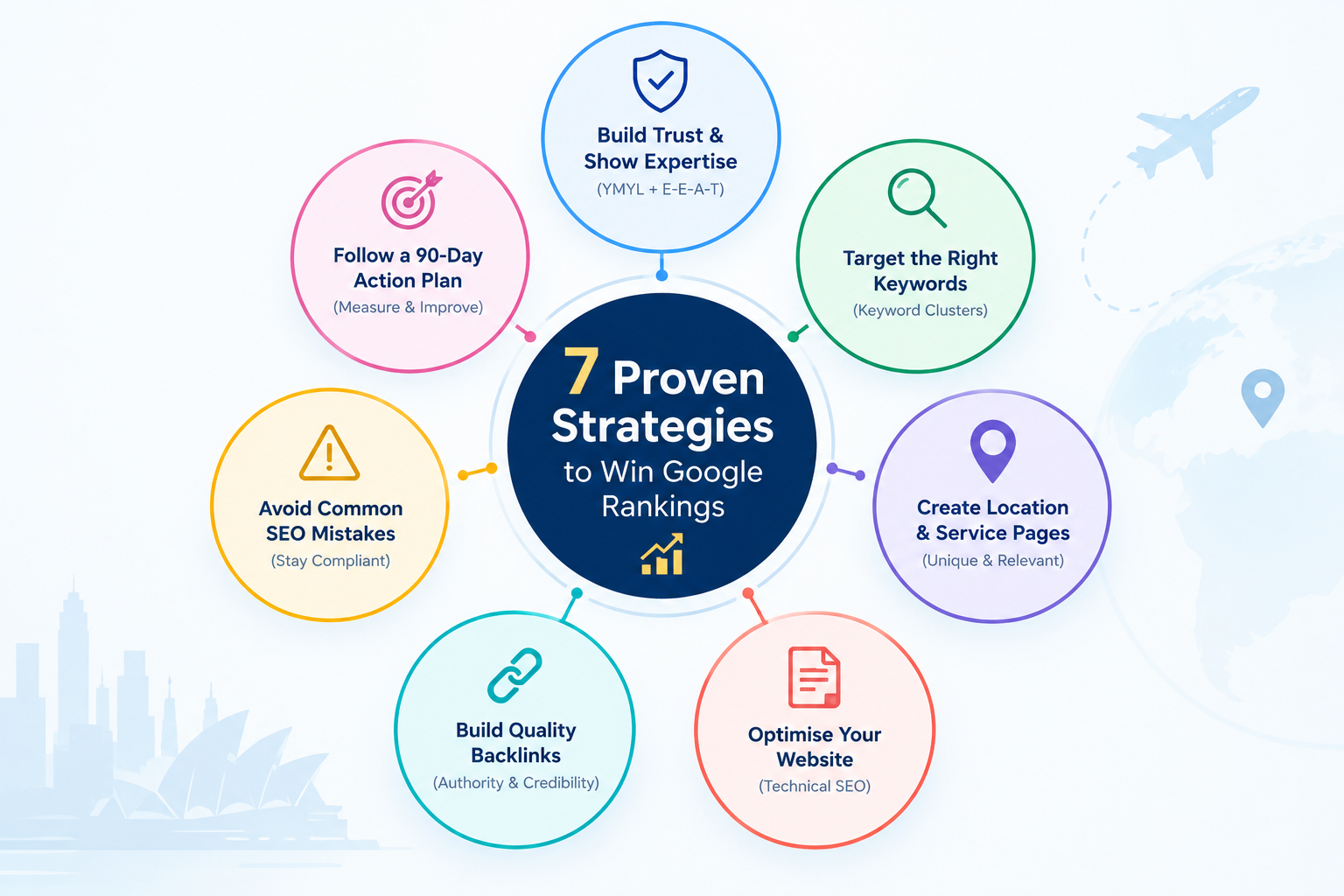
Experience, Expertise, Authoritativeness, and Trust are not abstract concepts for a migration agency – they translate directly into named consultant bios with registration numbers, genuine client outcome stories, and an About page that reads like a real, accountable business rather than an anonymous lead-gen site.
Experience
Show, don’t just claim, real-world experience: years in practice, number of cases handled, specific visa subclasses your team has direct experience with. Vague claims like “years of combined experience” carry far less weight than specific, checkable detail.
Expertise
Content written by, or reviewed by, someone with genuine subject-matter knowledge outperforms generic, outsourced copy – and increasingly, Google’s systems can tell the difference. Byline your content with the consultant who actually contributed to it wherever possible.
Authoritativeness
Being cited, linked to, or mentioned by other credible sites in your space – professional associations, local news coverage, partner institutions – signals to Google that other trusted sources vouch for you, which carries more weight than anything you say about yourself.
Trust
Trust is the most concrete of the four in this niche: display each consultant’s registration with the Office of the Migration Agents Registration Authority (OMARA), since it’s the regulator Google’s own quality raters are trained to look for when evaluating YMYL sites in this space. Pair that with accurate contact details, a real physical address, and visible, verifiable reviews.
(That OMARA reference above is also your outbound authoritative link for Rank Math’s external-linking check – it uses existing text from the sentence itself, so no rewording is needed to fit it in.)
Technical SEO Essentials
Beyond content and trust signals, the technical foundation of the site needs to be solid – technical problems can silently cap your rankings even when your content and E-E-A-T signals are strong.
Site Speed & Mobile Experience
Visa applicants frequently browse on mobile data, sometimes from overseas while travelling. Slow load times cost you both rankings (Google factors page speed into ranking) and visitors (a slow page loses people before they see your content at all). Compress images, avoid heavy unused scripts, and test your core pages on a throttled mobile connection, not just on office wifi.
Site Structure & Crawlability
Every service and location page should be reachable within a few clicks from the homepage, with a clean, logical URL structure and internal linking that helps both users and Google understand how your pages relate to each other. An orphaned page – one nothing else on the site links to – is far less likely to rank well no matter how good its content is.
Schema Markup
Structured data (schema) that clearly identifies your business type, services, location, and reviews helps Google understand and display your content more richly in search results – including star ratings and FAQ dropdowns. Rank Math generates most of this automatically once your business details and FAQ blocks are filled in correctly.
Getting these technical basics right matters just as much on the website side as it does in search – the same attention to structure, speed, and clarity is exactly what separates a merely functional site from a genuinely high-converting consultancy website.
Common SEO Mistakes Migration Agencies Make
- Publishing generic “we help with all visas” pages instead of dedicated pages per visa type or destination
- Letting content go stale – visa rules and fees change frequently, and outdated information actively damages trust signals
- No named, credentialed consultants visible anywhere on the site
- Duplicating location pages with only the city name swapped out
- Treating SEO as a one-time project rather than an ongoing effort – a site that hasn’t been touched in a year loses ground to competitors who are actively publishing
- Ignoring technical basics like page speed and mobile experience while focusing only on content
Fixing even the first three of these resolves most of the E-E-A-T gaps that keep migration agency sites stuck outside page one.
A Simple 90-Day SEO Action Plan
Rather than trying to fix everything at once, sequence the work so foundational trust signals go in first, since they influence how Google evaluates everything you publish afterwards.
| Phase | Focus | Outcome |
| Days 1–30 | Add named consultant bios with registration numbers; fix duplicate location pages; complete Google Business Profile | Trust and E-E-A-T foundations in place |
| Days 31–60 | Publish 3–4 problem-driven and process-term blog posts; add schema markup and FAQ blocks | Content depth and structured data begin feeding rankings |
| Days 61–90 | Review Search Console data to see which clusters are gaining impressions; expand the strongest-performing content; fix any remaining technical issues | Data-informed second wave of content and technical fixes |
Conclusion
SEO for immigration consultants isn’t a variant of local SEO with a few extra keywords – it’s a fundamentally different discipline, because Google is checking whether it can trust your site with content that affects someone’s visa, their finances, and sometimes their entire future.
Every recommendation in this guide traces back to that one fact: named, credentialed consultants beat anonymous copy; unique location pages beat duplicated ones; specific, checkable trust signals beat vague claims of experience.
Get the foundations right first – E-E-A-T signals, unique location pages, and technical basics – and the keyword and content work in the sections above will have something solid to build rankings on top of. Skip the foundations, and even excellent content will struggle to break through in a niche where Google is actively looking for reasons not to trust a site.
FAQ
Q: Why does YMYL content need to meet a higher SEO bar?
A: Because immigration guidance can materially affect someone’s finances and life circumstances, Google applies stricter expertise and trust evaluation to this content than to lower-stakes topics.
Q: How long does SEO take to show results for a migration agency?
A: Typically 4 to 6 months for competitive terms, though long-tail process and problem-driven terms can rank faster.
Q: Can we do migration agency SEO ourselves?
A: The basics – Google Business Profile, service pages, named consultant bios – are doable in-house; competitive keyword strategy and technical SEO usually benefit from specialist support.
Q: Do we need to update old blog content?
A: Yes – visa fees, processing times, and rules change often, and Google can penalise outdated YMYL content even if it once ranked well.
Q: Does displaying OMARA (or an equivalent regulator) registration actually affect rankings?
A: Indirectly, yes – it’s one of the concrete trust signals Google’s quality raters are trained to look for on YMYL sites, and it also directly reassures visitors, which improves conversion even where it doesn’t move rankings on its own.
Q: What’s the single highest-impact fix for a migration agency site that’s stuck outside page one?
A: In most cases, replacing duplicated or generic location pages with unique, locally specific content – this single fix resolves both a content-quality problem and a trust-signal problem at once.
Want a free SEO audit that shows exactly where you’re losing rankings to competitors? Book one with The Purple Bytes.